The Wicker Man at 50: how the strange 1970s British film became a cult classic

It may have got off to a shaky start, but The Wicker Man is now one of British film’s best-loved horror stories, thanks to its deeply disturbing plot.

By Gill Jamieson

It tops the poll of the 50 greatest British horror films, according to readers of Horrified Magazine, while the Guardian pitches it at number four in its list of the 25 greatest horror films.

David Bartholomew of Cinefantastique magazine described The Wicker Man as “the Citizen Kane of horror films.

Bizarrely, it even has its own rollercoaster ride in the British theme park Alton Towers. Made of wood, naturally.

But when the film was released on December 6 1973, the studio behind it – British Lion – tried to bury it with a limited release. It was briefly tacked on as the supporting feature in a double bill with Nicolas Roeg’s atmospheric psychological thriller Don’t Look Now.

However, The Wicker Man has grown in stature over the years and is now considered a cult classic. A remarkable change in fortunes for a film described by its own music designer, Gary Carpenter, as being about “semi-mystical occult shit”.

A middle aged man sitting on a doorstep wearing a shirt, cravat and cardigan.

The film was directed by novice Robin Hardy and written by Anthony Shaffer, a credible dramatist who had just finished working with Alfred Hitchcock on Frenzy (1972). But the production gained traction with the support of Christopher Lee who would take on the role of charismatic cult leader Lord Summerisle.

Lee, by that point a huge star and cemented in the public imagination as Count Dracula (of Hammer Horror fame), gave much of his time to ensure the production got off the ground.

Reversal of horror tropes

It’s an unsettling story that commences with the arrival of devout Christian police officer (Sergeant Howie, played convincingly by Edward Woodward) on the remote island community of Summerisle, in search of a missing girl.

Hardy has explained that they key to understanding the appeal of the film is that it’s a satisfying puzzle that rewards repeat viewing:

Essentially, one must think of The Wicker Man as a game, with clues gradually suggesting Summerisle is not run in accordance with the Christian values of Sergeant Howie. Setting it in Scotland was crucial: in the early 1970s, Christianity was still widely practised, and it had a very puritan aspect.

The audience share Howie’s narrative viewpoint, experiencing the island for the first time and noticing, as he does, the peculiarities and practices of a community at odds with conventional society. From the sweet shop window with its phallic confectionary to the couples openly copulating after a night at the Green Man pub, the sense of weirdness is palpable.

As Howie’s investigation progresses, it becomes clear that the community have embraced a way of life that rejects Christian values in favour of pagan rites and rituals. From the hapless beetle tethered to a nail in the schoolroom to the placing of a frog in the mouth of a child suffering from a sore throat, this is an isolated community committed to an alternative belief system. The film succeeds in tapping into a rich repertoire of folk imagery to build incrementally to its harrowing conclusion.

It transpires the investigation is a trap carefully orchestrated by the islanders to secure a suitable human sacrifice for their May Day celebrations to rectify the drought that has blighted their apple harvest. Howie’s fate is sealed in a giant wicker effigy set alight in front of the islanders.

The story derives much of its power from its thrilling reversal of the commonplace horror trope that sees young women victimised. Rather, it offers a “male in peril” story made all the more terrifying because the man in question is an upstanding authority figure, a man utterly convinced of the rightness of his convictions.

The film used around 25 different locations in Scotland. These served the production well despite notorious filming conditions. The early summer setting was in fact shot from October through to November.

It remains a rich slice of cultural geography with a vivid sense of place that is entirely in keeping with the folk horror of the subject matter. It feels authentic. Diehard fans can follow The Wicker Man trail, a tour of the most famous filming locations such as Anwoth Kirk, Culzean Castle, Plockton and Kircudbright, amongst others.

Shocking ending

The film also features impressive production design despite its relatively modest budget. There are some film sequences that live long in the imagination because of the sheer scale of the production and the evident commitment to the craft of special effects.

Great films are remarkable for pushing the envelope in terms of what can be accomplished with their production design: think of the burning of Atlanta sequences in Gone with the Wind (1939) or Skull Island in King Kong (1933). The Wicker Man has such a sequence to rival anything seen in film history.
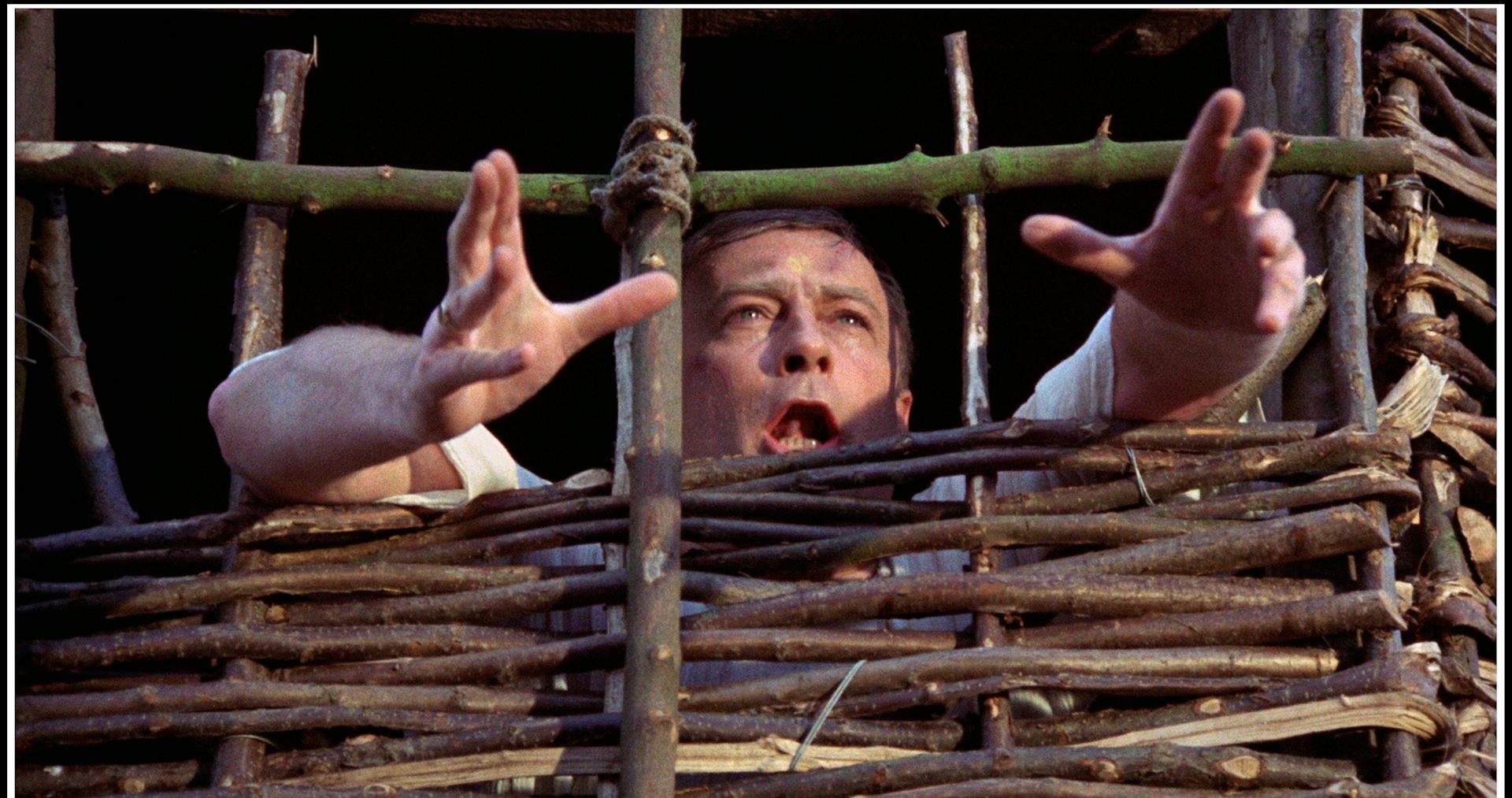
A man imprisoned in a makeshift prison made of wood, his hands outstretched in plea.
The end of The Wicker Man is truly disturbing. TCD/Prod.DB / Alamy

As the May Day celebrations snake down to the beach it is revealed that the missing girl is alive and well after all: Howie has been duped. Lord Summerisle patiently explains to Howie his fate has been predetermined from the outset and he is then forcibly hoisted into a giant wicker colossus (alongside a number animals) where he is to be burned alive.

Drawing on tales of druid sacrificial rituals, the sequence provides one of the most haunting spectacles in film history. The ending is horrifying because it is a “reveal”: this is what the islanders had in mind all along. Howie’s entrapment is our entrapment: we too have been fooled.

The very drab ordinariness of Summerisle with its sweet shop and post office, cosy village pub and modest schoolhouse, conceals a community enthusiastically committed to human sacrifice. The shocking ending would be instrumental in elevating the film and securing The Wicker Man’s place in the horror film canon.

Source: The Wicker Man at 50: how the strange 1970s British film became a cult classic

Maypole on Fire: The Importance of Music in the Original ‘The Wicker Man’

The musical delights lure you in before you’re ensnared like the doomed Police Sergeant.

By Chris Sasaguay

The Wicker Man (1973) is an early entry of the folk horror subgenre. It gave Christopher Lee his favorite role, keeping the danger from his portrayal as Dracula but leaving behind bloody fangs for something more concealed. This subtlety isn’t only for his character. Director Robin Hardy and screenwriter Anthony Shaffer use subtlely throughout the whole movie, making its shock ending that more shocking. The true power in unnerving the audience is not so much that fiery visual. It’s the music heard throughout. Italian-American musician Paul Giovanni created the soundtrack with musical support by British band, Magnet. Instead of relying upon dialogue exposition, the featured songs let the audience in on the pagan customs central to the story. From sexually-charged tunes to more somber pieces, the folk music disarms the movie’s audience as much as the climatic sacrifice succeeds in terrorizing.

Police Sergeant Howie (Edward Woodward) arrives at the island of Summerisle and quickly experiences the strange lifestyle of its pagan residents. As a devout Christian, this man of law and order is continuously made to be the outsider. What is baffling to him, is absolutely normalized to the island’s young and old. He’s searching for a missing girl, but it’s all an elaborate ploy to entrap Howie. The islanders plan to sacrifice him to their sun god, with the hopes it will help the upcoming crops.

Early on, Woodward’s character is standing within the pews of a church, not having left for the seaplane yet. Together with fellow parishioners, he sings the hymn, “The Lord’s My Shepherd.” It’s full of passion, the words meant to offer comfort. The church’s organ echoes all around. But from everyone’s wooden stance, it’s all so rigid. In fact, it could be considered joyless, despite the pious sense of fulfillment on display. Howie is standing next to a woman who is his fiancée, a character who doesn’t show up after this. For her one appearance, they share no kiss or any kind of intimacy, adding on to the conservative aspects to Howie’s character. This isn’t the last time “The Lord’s My Shepherd” is heard. But when it returns, the circumstances are far different and lonelier.

Once Howie is in the sky, Giovanni’s folk music begins with “Corn Rigs,” the vocals also performed by the composer. “I loved her most sincerely, I kissed her o’er and e’er again, among the rigs of barley,” and so it goes. The lyrics are taken from the poetry of 18th-century Robert Burns, old words like the old religion being practiced on the approaching island. There’s a twang from an acoustic guitar, making it sound quite peaceful. There is no obvious hint of the menace to come. Instead, there are hints to the sexual liberation of the pagans. Listening to the lyrics, it tells of a pair of lovers who use barley rigs as cover, a means to hide from moralistic eyes such as the Police Sergeant. On first watch, it may not seem evident, but there is an unsettling intention behind the music. It plays over the establishing shots captured by cinematographer Harry Waxman. There is so much ocean the plane passes over, Summerisle is truly cut off from the rest of the world.

The-Wicker-Man-film-Robin-Hardy

On land, Howie enters the Green Man Inn, getting stuck in the middle of a sexually-charged, rowdy chorus. Male islanders holler to “The Landlord’s Daughter,” directed towards Willow (Britt Ekland), the daughter of the Inn’s owner. But she watches in happiness. The Police Sergeant is the one unamused, listening to, “And when her name is mentioned, the parts of every gentleman do stand up at attention.” The loud voices instantly make Howie look uptight and out of place. Sex is on the mind of this community, but they don’t always lean towards being raunchy. As Howie heads to a guest room, the patrons downstairs ease their energy. Christopher Lee’s Lord Summerisle then makes an appearance, introducing Willow to a young man who she takes to her bedroom. The patrons glance upstairs as they sing to “Gently Johnny,” a ritual-like song acknowledging the bedroom antics. All the while, Lord Summerisle monologues over two snails mating outside, making the connection between nature and sex for this community. Howie tries to sleep but the sounds coming from Willow’s room keep him tossing and turning. Nothing explicit is shown but the patrons singing, “I put my hand all on her breast” and “I put my hand all on her thigh,” leave little to the imagination. For Howie, this premarital sexual freedom is startling. All around, humans and creatures alike are embracing what this God-fearing man denies himself.

The following day, the Police Sergeant watches a teacher and pupils dance around a maypole on the school yard. No wooden pews keep them in place, those have been left in the old church behind the festive maypole. The song is innocent at first, quick-paced and child-like. Then it continues. The kids merrily sing to sex, birth, and rebirth. Once someone dies, the islanders believe they are reincarnated as a tree, becoming one with the nature they worship. Upon a closer look, the school children are separated by gender. The boys are outside, worshiping the maypole. Inside the school house, the girls are listening to Miss Rose (Diane Cilento) talk about the phallic symbolism associated with it. On the mention of this, Howie storms into the classroom. He berates the teacher Miss Rose for tainting the young minds with what is essentially the topic of reproduction. The adults and now the children act in ways Howie can’t grapple with. And they do so with so much pleasure. Miss Rose holds another role, leading to a more mysterious entry on Giovanni’s soundtrack.

the wicker man 1973 image

The soft blows from a flute introduce “Fire Leap.” The school teacher watches over a group of nude women in a fertility ritual, surrounded by majestic standing stones. One by one they jump over a fire, chanting, “Take the flame inside you, burn and burn belong.” It’s very dream-like, made more so with the women’s voices low and whispery. Seeing the naked women in broad daylight makes Howie uncomfortable on another level. Then he gets targeted more directly.

Read more

The Wicker Man: 1973 folk-horror endures to this day as a masterpiece of the form

Free love and folk-singing hides a dark secret on the Scottish island of Summerisle in a film that’s bracing, exciting and downright funny

By Shaad D’Souza

Have you seen the horror film about a gormless, well-intentioned westerner lured to a lush, sparsely populated isle in search of meaning, only to find paganism, unbridled sexual politics, folk dancing and abject violence?

I’m not talking about Midsommar, the 2019 folk-horror hit by auteur Ari Aster that freaked out audiences with its broad-daylight senicide and twee ritualism. I’m referring to a film that came out nearly 50 years earlier, and which often out-weirds and out-wilds its younger cousin despite containing none of the gore or violence. I’m talking about The Wicker Man, the 1973 British horror-musical that popularised the folk-horror genre, and endures to this day as a masterpiece of the form.

Directed by Robin Hardy, The Wicker Man is a strange but essential B-movie artefact, one which has, over the past 20 years, been reclaimed as a masterpiece of British cinema and now has a home on prestige streaming platform Mubi. Starring Edward Woodward and iconic 60s actress and sex symbol Britt Ekland, the film follows police sergeant Neil Howie who receives an anonymous tip that a young girl has gone missing on the far-off Scottish island of Summerisle.

When he arrives, he finds that he’s bitten off far more than he can chew. Not only are the island’s residents cheerily working together to obfuscate the details of what happened to the girl, they also seem to have given up on Christianity entirely – worshipping pagan gods and conducting a sinister masked procession on May day.

The devoutly Christian sergeant is appalled – villagers roaming naked and having sex in the lush fields, churchyards overrun with wildlife and entirely devoid of Christian symbology, school lessons on the phallic origins of the maypole, and a suave, smartly dressed lord, played by Christopher Lee, who rules in place of an elected official. Most sinister of all is that despite their wide grins and penchant for song and dance, Howie is pretty certain the missing girl has been given up as a human sacrifice in exchange for an abundant harvest.Devoid of any “traditional” horror devices – jump scares, gore and the like – The Wicker Man instead asks viewers to draw their own conclusions about the traditions of Summerisle. (As with Midsommar, I found the supposedly barbaric villagers to be sympathetic and perversely reasonable, but the film allows for any number of interpretations while still being straightforward and accessible, one of its greatest formal triumphs.) What transpires over the course of the film is unsettling and often bizarre, but also poses salient questions about tradition, judgment and moral relativism. And it does it all in a breezy, evenly paced 88 minutes. Although sometimes arcane in its references, I cannot express how bracing, exciting and downright funny a first watch of The Wicker Man is.

Source: The Wicker Man: 1973 folk-horror endures to this day as a masterpiece of the form