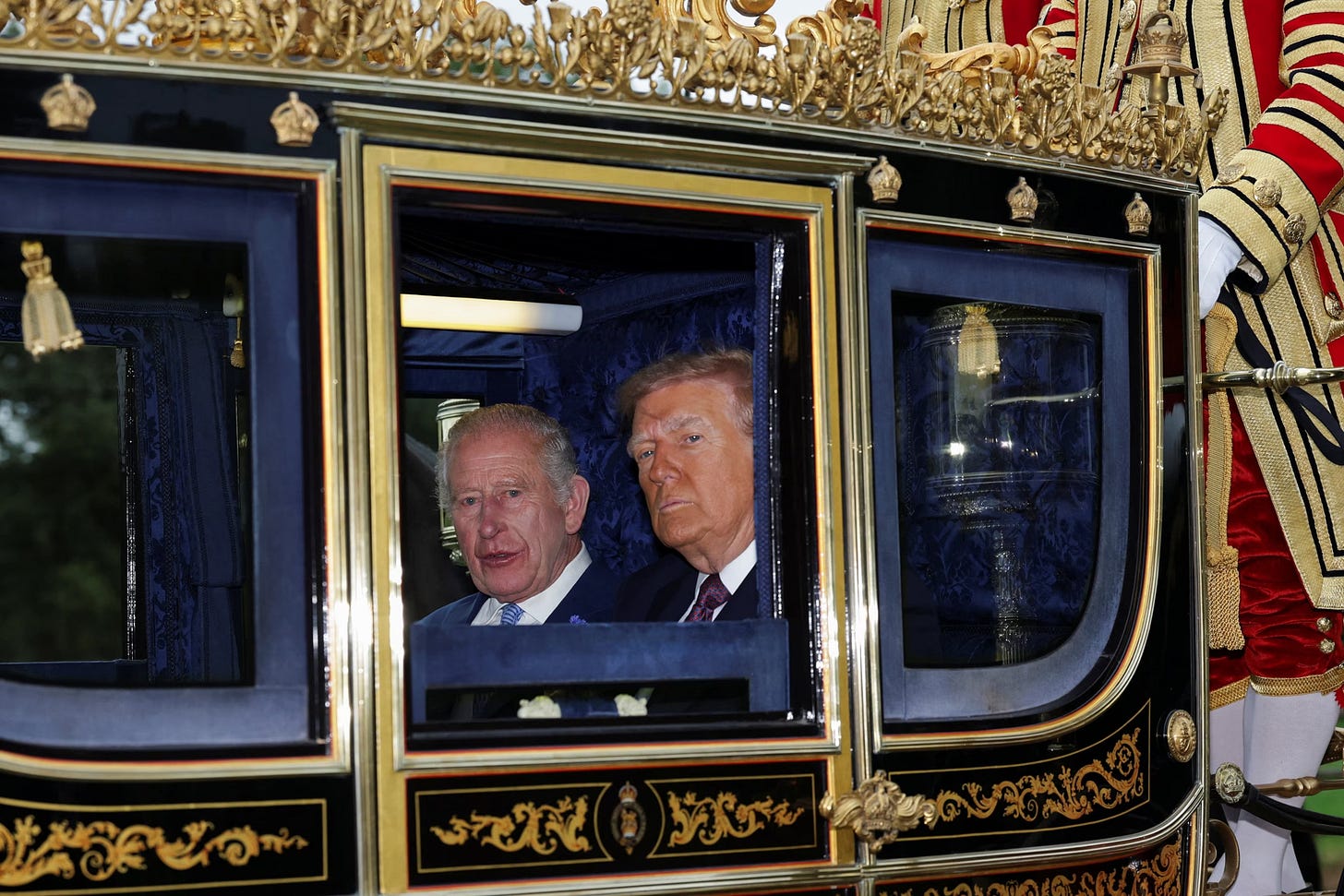
The U.K. arrests Price Andrew. Why shouldn’t the U.S. arrest King Trump, who appears to have done even worse?

If no one is above the law, then no one is above the law

By Robert Reich

Police in the U.K. have arrested Andrew Mountbatten-Windsor, the former Prince Andrew and Duke of York, on suspicion of misconduct in public office — after the disclosure of emails between Mountbatten-Windsor and the late disgraced banker Jeffrey Epstein. As I write this, Mountbatten-Windsor remains in custody.

We don’t know yet the specific charges. But we do know that the late Virginia Giuffre, an Epstein victim, accused Mountbatten-Windsor of raping her.

We also know that Mountbatten-Windsor was the U.K.’s trade envoy between 2001 and 2011, and appears to have forwarded to Epstein confidential government reports from visits to Vietnam, Singapore and China, including investment opportunities in gold and uranium in Afghanistan.

Prime Minister Keir Starmer says “no one is above the law.” The family of Virginia Giuffre says “no one is above the law, not even royalty.” Britain’s chief prosecutor says “no one is above the law.”

All of which raises awkward questions about the people implicated on this side of the pond, including the person in the Oval Office who loves to be treated like a king, and who appears in the Epstein files 1,433 times (that is, the files that have been released so far). Prince Andrew appears in them 1,821 times.

America likes to believe we gave up kings almost 250 years ago and adopted a system in which “no one is above the law.”

But Trump’s foreign policy has become a personal tool for him to channel money and status to himself and his closest associates. Since the 2024 election, the Trump family’s personal wealth has increased by at least $4 billion.

As with the British royalty of the 16th century, it’s all personal with Trump — all about expanding his power and enlarging his and his family’s wealth. Proceeds from the sale of Venezuelan oil? “That money will be controlled by me,” he says. The gift of a plane from Qatar? “Mine.” Investments by Middle-East kingdoms in his family’s crypto racket? “Perfectly fine.”

Like the British royalty of yore, King Trump has arbitrary power. He raises Switzerland’s tariff from 30 to 39 percent because its former president Karin Keller-Sutter “just rubbed me the wrong way.” He imposes a 50 percent tariff on Brazil because Brazil refused to halt its prosecution of Trump’s political ally, the former Brazilian president Jair Bolsonaro, who was found guilty of plotting a coup. Vietnam fast-tracks approval of a $1.5 billion Trump family golf course at the same time it seeks to reduce its tariff rate.

Trump claims that Greenland is “psychologically needed,” although the United States already has a military presence there and an open invitation to expand its bases. He muses about making Canada the “51st state.” These are throwbacks to the 16th-century age of empire.

***

Meanwhile, Trump has created a system of tribute and allegiance that would make Henry VIII jealous.

Apple’s Tim Cook delivers a gold-based plaque and a donation to Trump’s planned ballroom. Swiss billionaires bring a gold bar and a Rolex desk clock to the Oval Office. Jeff Bezos backs a vapid movie of Melania and hands her a check for $28 million.

Trump pardons Changpeng Zhao, the billionaire mogul who pled guilty to money-laundering violations in 2023, after which time Zhao’s Binance digital-coin trading platform becomes the engine of the Trump family’s crypto business, World Liberty Financial.

Elon Musk’s humongous quarter-billion-dollar contribution to Trump’s 2024 campaign earns Musk a dukedom — a “department of government efficiency”— and the keys to the kingdom in the form of sensitive U.S. Treasury Department software systems used to manage federal payments.

But when the Duke of DOGE starts becoming more visible than King Trump, the king banishes him and revokes his dukedom. When the banished Musk begins openly criticizing Trump, the king threatens to cut off Musk’s head in the form of cutting him and his SpaceX off from valuable government contracts. This puts an end to Musk’s impertinence.

The new TikTok (on which Trump has more than 16 million followers) will continue operating in the United States — but now with the financial backing of Trump ally Larry Ellison’s Oracle, Trump’s allied Emirati investment firm MGX (which has already invested in the Trump family’s cryptocurrency company), and Silver Lake, teamed up with the private equity firm founded by Trump’s son-in-law Jared Kushner.

Trump allows Nvidia to sell chips to the United Arab Emirates and Saudi Arabia and extends military guarantees to Qatar — all of which have invested in the Trump family empire. (Emirati-backed investors plowed $2 billion into World Liberty Financial.)

Instead of national glory, Trump demands personal glory — to get the Nobel Peace Prize, to put his name on the Kennedy Center and Penn Station, and other major monuments and buildings.

If his commands are not met, he punishes. Because Norway didn’t give him a Nobel (it wasn’t Norway’s to give anyway), he “no longer feels obliged to think only of peace.” Because performers refuse to appear at the “Trump-Kennedy” Center, he shutters it.

Instead of bureaucracies, America now has a royal entourage. Instead of institutions, we now have royal prerogative. Instead of legitimacy based on the will of the people, there’s divine right (“I had God on my side,” “God was protecting me,” “God is on our side”).

***

We will march against King Trump on the next “No Kings Day” on March 28 — hopefully making it the biggest protest in American history.

But the arrest of the former Prince Andrew raises an issue that goes way beyond protesting and marching. King Trump was evidently involved in Jeffrey Epstein’s nefarious doings. We don’t know exactly how because there’s been no criminal investigation. But shouldn’t there be?

Trump has also been enriching himself and his family through his public office, violating multiple laws about conflicts of interest.

If the U.K. can arrest the former Prince Andrew on evidence of such wrongdoing, why shouldn’t America arrest King Trump? If no one is above the law in the U.K., not even royalty, presumably no one is above the law in the U.S., not even a president.

Pam Bondi obviously won’t investigate Trump because she’s part of King Trump’s court. But what about a group of state attorneys general?

Almost 250 years after we broke with George III, the question must now be faced: Are we a monarchy or a nation of laws?

Source: The U.K. arrests Price Andrew. Why shouldn’t the U.S. arrest King Trump, who appears to have done even worse?

Sarah Kendzior: Shipwreck on Zombie Road

Sarah Kendzior

Vindication means nothing without justice.

By Sarah Kendzior | Feb 17, 2026

There is a shipwreck at the end of Zombie Road. I walked miles to see it: past moss-covered cliffs and century-old railroad tracks half-buried in the earth. I hadn’t hiked Zombie Road since 2022, when an elderly woman I used to pass on the trail disappeared. I didn’t know her name, but I knew her smile. When she went missing, I checked the news round the clock, hoping she would be found. Her face is on a memorial bench now. I put a flower there.

I finally felt ready to return to Zombie Road. 2026 leaves you ready for everything and nothing. I live in a nightmare echo chamber where topics I covered for over a decade in my books and articles — autocracyinstitutional complicity, extremely specific details of the Epstein/Maxwell case — are now repeated by the same pundits and officials who dismissed them when it mattered most. They buried crimes in silence, then noise, and now spectacle.

The lack of accountability stays the same.

Sarah Kendzior’s Newsletter is a reader-supported publication. To receive new posts and support my work, consider becoming a free or paid subscriber.

People ask if I feel vindicated. It’s an evil question. I wanted justice, not approval. No one needed to vindicate me. I knew I was right: I wanted the world to make me wrong. Facts are facts, and cowards are cowards, and belated recognition of obvious crimes does not negate the harm done to victims.

What the truth can do is shine a light to a better future. But officials behave as if the future is foreclosed. They rush toward evil in every form: genocide, eugenics, the replacement of humanity with artificial intelligence. They are part and parcel with the predators they were supposed to expose and condemn and prosecute.

They always were.

* * *

I go to Zombie Road because it doesn’t lie, no matter how it changes. The haunted path winds between hulking hills that were once Native American burial mounds. I pass a signpost that says “Zombie West, Zombie East” with mileage markers for trails.

Over the past decade, Zombie Road got gentrified. One of St. Louis’s most notorious sites — where locals claim to see the reanimated corpses of train robbers and Civil War soldiers and “a shadow nest of children” on the cliffs at night — now boasts mountain biking and hilltop McMansions. County officials decided to lean into the zombie lore instead of feigning respectability. It was the right move.

“Zombie West, Zombie East.” That’s how it feels to live in the middle of a technofascist criminal syndicate spanning the globe.

We no longer watch the news: the news watches us. Stories written by robots are posted on websites that suck personal information from our phones and hand it to data miners controlled by oligarchs. “Journalists” brag that they rely on AI to map the child rape networks that they once denied existed; the networks that include the very oligarchs breeding the AI. They dig humanity’s grave and stagger back out of it.

“Fake news” used to mean propaganda or inconvenient truths that Trump deemed lies. Now fake news is news written by non-human entities hallucinating a counterfeit reality. It is fake without motive, fake for the sake of being fake and making you lose confidence that anything can be real. It is zombie news for zombie consumption.

“When someone shows you who they are, believe them the first time,” St. Louis native Maya Angelou famously said.

When people refuse to admit that a conspiracy of wealthy predators is real — even though it has been documented publicly since Epstein was first indicted in 2006, confirmed by dozens of victims over decades, and investigated by journalists who were threatened by the perpetrators and their lawyers — believe that these denialists were acting as enablers the first time, and never grant them your trust.

They are zombies. They eat pain and spit it out as content in an attempt to inure you to the depths of depravity. They want voyeurism, not accountability. If they wanted justice, they would have believed the trafficked child rape victims the first time. If they had integrity, they would have not only surrendered their access to criminal elites when the story broke years ago but been ashamed that they ever coveted it.

I believe in redemption, but not for this. Not for the predators, not for the enablers. This has always been a clearcut case. This has always been a spiritual war.

* * *

The shipwreck lies on a sandbar off deep blue water where icebergs drift like silver rafts. This stretch of the Meramec River is isolated and idyllic, an oasis of driftwood and birdsong. Locals nicknamed it the River of Death for all the people who drowned here. Euphemisms do no good in a dystopia.

I’d seen the shipwreck when the water was high enough to form a barrier around it. Now the river ran low, and a brush trail led to a steep incline where I could climb down to the ruins. I could see the hull and a rusted red entryway shaped like a shack. A tree grew in the midsection. It had been there a long time.

I’ve been told this is not really a shipwreck, but the remains of a gravel barge that crashed some fifty years ago. I still call it a shipwreck, because you still call this a government, and that crashed some fifty years ago too.

I was a woman alone on the river of death in winter. This adventure was unwise, but no more unwise than investigating an international crime syndicate of wealthy pedophiles for ten years, so I decided to explore.

I slid to the ground and peered into the barge. Rotting equipment lay by a pile of tires. Someone else had been here. Iron hooks lined a concrete outer wall where the boat used to dock. I wondered why no one bothered to fix the ship or remove it. I don’t want them to do that: the wreck is too interesting. It made me feel like a child again, a child unbothered, a child unaware of how her country treats children.

I felt safe in my shipwreck because I was far from the men with the yachts.

* * *

I hopped over ice puddles and climbed back to Zombie Road. I followed the train tracks into the woods and walked past the skeleton of an animal, hollowed out so only its head and spinal cord remained, and wondered what picked it clean.

I thought of all the people who had walked this trail for centuries, and the terrible things they had witnessed, and how nothing seemed to match the horrors in my 21st-century mind. The patterns of elite criminality and complicity, the patterns I can’t comprehend why others refused for so long to see.

I sat on a bench and closed my eyes and mourned the unbelieved.

When I looked up, two trees were hugging. One stretched out its branches in a warm embrace and the other leaned in. They were in love and they didn’t care who knew it.

I felt grateful that whatever part of me let me see the dystopia coming let me see that too.

* * *

Sarah Kendzior’s Newsletter is a reader-supported publication. To receive new posts and support my work, consider becoming a free or paid subscriber.