
It may have got off to a shaky start, but The Wicker Man is now one of British film’s best-loved horror stories, thanks to its deeply disturbing plot.
By Gill Jamieson
It tops the poll of the 50 greatest British horror films, according to readers of Horrified Magazine, while the Guardian pitches it at number four in its list of the 25 greatest horror films.
David Bartholomew of Cinefantastique magazine described The Wicker Man as “the Citizen Kane of horror films.
Bizarrely, it even has its own rollercoaster ride in the British theme park Alton Towers. Made of wood, naturally.
But when the film was released on December 6 1973, the studio behind it – British Lion – tried to bury it with a limited release. It was briefly tacked on as the supporting feature in a double bill with Nicolas Roeg’s atmospheric psychological thriller Don’t Look Now.
However, The Wicker Man has grown in stature over the years and is now considered a cult classic. A remarkable change in fortunes for a film described by its own music designer, Gary Carpenter, as being about “semi-mystical occult shit”.

The film was directed by novice Robin Hardy and written by Anthony Shaffer, a credible dramatist who had just finished working with Alfred Hitchcock on Frenzy (1972). But the production gained traction with the support of Christopher Lee who would take on the role of charismatic cult leader Lord Summerisle.
Lee, by that point a huge star and cemented in the public imagination as Count Dracula (of Hammer Horror fame), gave much of his time to ensure the production got off the ground.
Reversal of horror tropes
It’s an unsettling story that commences with the arrival of devout Christian police officer (Sergeant Howie, played convincingly by Edward Woodward) on the remote island community of Summerisle, in search of a missing girl.
Hardy has explained that they key to understanding the appeal of the film is that it’s a satisfying puzzle that rewards repeat viewing:
Essentially, one must think of The Wicker Man as a game, with clues gradually suggesting Summerisle is not run in accordance with the Christian values of Sergeant Howie. Setting it in Scotland was crucial: in the early 1970s, Christianity was still widely practised, and it had a very puritan aspect.
The audience share Howie’s narrative viewpoint, experiencing the island for the first time and noticing, as he does, the peculiarities and practices of a community at odds with conventional society. From the sweet shop window with its phallic confectionary to the couples openly copulating after a night at the Green Man pub, the sense of weirdness is palpable.
As Howie’s investigation progresses, it becomes clear that the community have embraced a way of life that rejects Christian values in favour of pagan rites and rituals. From the hapless beetle tethered to a nail in the schoolroom to the placing of a frog in the mouth of a child suffering from a sore throat, this is an isolated community committed to an alternative belief system. The film succeeds in tapping into a rich repertoire of folk imagery to build incrementally to its harrowing conclusion.
It transpires the investigation is a trap carefully orchestrated by the islanders to secure a suitable human sacrifice for their May Day celebrations to rectify the drought that has blighted their apple harvest. Howie’s fate is sealed in a giant wicker effigy set alight in front of the islanders.
The story derives much of its power from its thrilling reversal of the commonplace horror trope that sees young women victimised. Rather, it offers a “male in peril” story made all the more terrifying because the man in question is an upstanding authority figure, a man utterly convinced of the rightness of his convictions.
The film used around 25 different locations in Scotland. These served the production well despite notorious filming conditions. The early summer setting was in fact shot from October through to November.
It remains a rich slice of cultural geography with a vivid sense of place that is entirely in keeping with the folk horror of the subject matter. It feels authentic. Diehard fans can follow The Wicker Man trail, a tour of the most famous filming locations such as Anwoth Kirk, Culzean Castle, Plockton and Kircudbright, amongst others.
Shocking ending
The film also features impressive production design despite its relatively modest budget. There are some film sequences that live long in the imagination because of the sheer scale of the production and the evident commitment to the craft of special effects.
Great films are remarkable for pushing the envelope in terms of what can be accomplished with their production design: think of the burning of Atlanta sequences in Gone with the Wind (1939) or Skull Island in King Kong (1933). The Wicker Man has such a sequence to rival anything seen in film history.
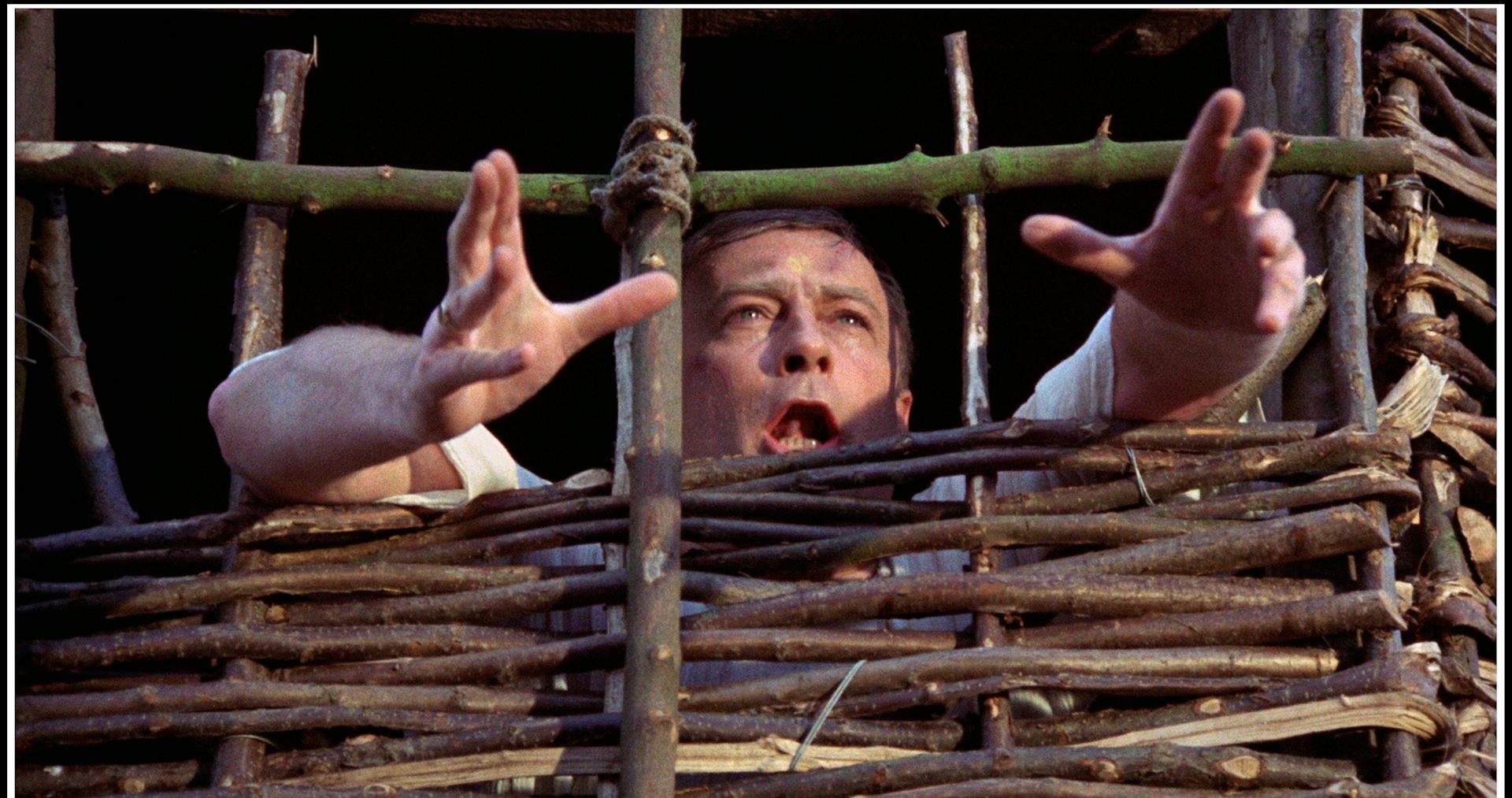
As the May Day celebrations snake down to the beach it is revealed that the missing girl is alive and well after all: Howie has been duped. Lord Summerisle patiently explains to Howie his fate has been predetermined from the outset and he is then forcibly hoisted into a giant wicker colossus (alongside a number animals) where he is to be burned alive.
Drawing on tales of druid sacrificial rituals, the sequence provides one of the most haunting spectacles in film history. The ending is horrifying because it is a “reveal”: this is what the islanders had in mind all along. Howie’s entrapment is our entrapment: we too have been fooled.
The very drab ordinariness of Summerisle with its sweet shop and post office, cosy village pub and modest schoolhouse, conceals a community enthusiastically committed to human sacrifice. The shocking ending would be instrumental in elevating the film and securing The Wicker Man’s place in the horror film canon.
Source: The Wicker Man at 50: how the strange 1970s British film became a cult classic


