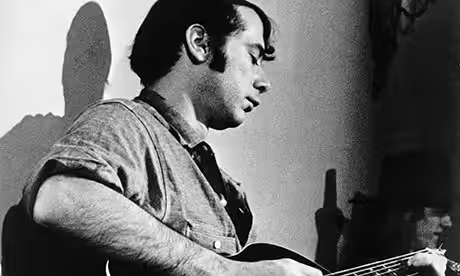
He adopted pseudonyms when no one had heard of him and drifted into poverty and alcoholism. But Fahey was one of the great pioneers of American blues and folk, as a new film shows
By Sean O’Hagan
I bought my first John Fahey album around about the same time that I discovered the novels and short stories of Richard Brautigan and the two American mavericks are linked in my consciousness to this day. The album in question was The Transfiguration of Blind Joe Death, originally released in 1965 in its ornately drawn gothic cover, on Fahey’s own Takoma label and later reissued on Transatlantic.
It may have been the way the name evoked the mythology of an older, lost America that made me connect it in some vague way with Brautigan book titles like Trout Fishing in America, In Watermelon Sugar and A Confederate General from Big Sur.
Both Fahey and Brautigan were makers of mischief as well as myths, who played around with form and tradition. Both seemed to belong to an older era – on the Picador book cover of Trout Fishing In America, Brautigan looks like he would have been quite at home hanging with the Band at Big Pink. In many ways, they were artists in thrall to what Greil Marcus famously called “the old weird America”, the traces of which remained only in folk stories and ballads, in the oldest, most primitive-sounding versions of folk, blues and country. But they were also, in their different ways, modernists negotiating their way mischievously and not altogether reverently into new forms, new languages.
As I found out much later, The Transfiguration of Blind Joe Death was a title intended to confuse. Likewise the strange overblown sleeve notes – “A disgusting, degenerate, insipid young folklorist from the Croat & Isaiah Nettles Foundation for Ethnological Research meandered mesmerically midst marble mansions in Mattapon, Massachusetts …” Fahey was having his own kind of fun at the expense of blues and folk music collectors, of which, ironically, he was one. The music, though, was something else: intricate, intriguing, multi-layered, resonant. It has stayed with me ever since, becoming, over the years, a constant.
That music is, in the main, solo and acoustic, played on a steel-stringed guitar. I distinctly remember my younger self being somewhat wary of buying an entire album of acoustic guitar instrumentals, but the more I listened to The Transfiguration of Blind Joe Death playing in the background as I browsed the racks of a now long-gone second-hand record shop in Camden Town, the more it cast its spell.
In Fahey’s hands, a single song can carry echoes of all the older musics he was drawn to – traditional folk ballads, blues, bluegrass, gospel, spirituals – but simultaneously sound somehow new and utterly unique. When he interprets an old song like John Henry or even Bicycle Built for Two, he reinvigorate it with the restless imagination of his playing. On Old Southern Medley, from The Transfiguration of Blind Joe Death, he even lists the musicians he is evoking: the great American songwriter Stephen Foster, Fahey’s beloved Charley Patton as well as Daniel Decatur Emmett, a self-taught songwriter and musician who founded the first blackface minstrel troupe in 1843.
Fahey’s tastes tended towards the old and overlooked, the strange and the primitive, and his guitar playing seems to summon up the spirits of long-dead blues and ragtime pioneers. More so than anyone apart from maybe the Bob Dylan of The Basement Tapes, he is perhaps the pivotal link between the various, almost-lost folk musics of another, older America and the singers and the contemporary musicians loosely grouped under the rubric of Americana.
In a new documentary on Fahey, In Search of Blind Joe Death: The Saga of John Fahey, which has is doing the rounds of indie film festivals and will be shown by BBC4 in December, the musicologist Rob Bowman, notes: “It’s hard to imagine what contemporary music would be like if people like John Fahey had not been obsessively fascinated with roots American music from the 1920s and 30s. That’s the secret of a whole swathe of modern rock’n’roll. It was his sense of collage, soundscape and dissonance that influence people like [Pete] Townshend, Thurston Moore and Beck.”
Perhaps surprisingly, it is Townshend who is most laudatory in his summation of Fahey, telling the film-makers: “Could I go so far as to say he is the innovator? I think yes … he is definitely worthy of the term iconoclast. He is in his own bubble.” That last part is true not just of Fahey’s playing, but his singular and singularly eccentric life. He was born in Takoma Park, Maryland on 28 February 1939. He bought his first guitar from Sears & Roebuck for $17, aged 14, and his first musical epiphany occurred when he heard Blind Willie Johnson’s Praise God I’m Satisfied on a 78rpm vinyl recording in a friend’s house.
“I started to feel nauseated so I made him take it off, but it kept going through my head so I had to hear it again,” he told the music writer Edwin Pouncey, in an illuminating interview for The Wire magazine in 1998. “When he played it the second time I started to cry, it was suddenly very beautiful. It was some kind of hysterical conversion experience where in fact I had liked that kind of music all the time, but didn’t want to. So, I allowed myself to like it.”
