Ex-special counsel testified in front of judiciary committee about aborted federal prosecution of Donald Trump
Jack Smith, the former justice department special counsel who led the aborted federal prosecution of Donald Trump, told a congressional committee that he never spoke to Joe Biden about his cases, according to the transcript of a deposition
In his behind-closed-doors testimony to the House judiciary committee earlier this month, Smith defended the charges he brought against Trump for allegedly possessing classified documents and attempting to overturn the 2020 election, while warning of the consequences of allowing election meddling to go unpunished.
“Theoretically, what happens if there is election interference and the people who are responsible for that are not held accountable?” Democratic congresswoman Pramila Jayapal asked.
“It becomes the new norm, and that becomes how we … conduct elections,” Smith replied, according to the transcript.
“And so the toll on our democracy, if you had to describe that, what would that be?” the congresswoman asked.
“Catastrophic,” Smith said.
Trump and his Republican allies have alleged that the former special counsel was a key figure in a justice department that Biden had “weaponized” against his predecessor. The Republican-controlled House judiciary committee earlier this year heard testimony from one of Smith’s top deputies, and months later subpoenaed the former special counsel for private testimony. Smith had offered to voluntarily testify in public, as special counsels typically do.
In questioning from Democratic congressman Dan Goldman, Smith said he operated without interference from Merrick Garland, the attorney general who appointed him, or any other top justice department officials. [ … ]
I spent September 9 in a cave. It wasn’t planned: I had been promised a waterfall. But there was a long drought, and the streams dried up, leaving a cavern of color and a series of interlocking caves. Cliffs soared above and holes gaped below, beckoning me to explore.
I waded through wildflowers and entered the largest lair, calling to my husband that I was alright, and crawled as far as I could go. The view from the cave was clearer than the view from the cliffs. In the dark, every detail of the outside world shines brighter. In the dark, I move slow and gradual, contorting myself to its crevices, observing everything and pursuing nothing. I took pictures because we had stopped at this park on a whim, and it was not supposed to look this way. I had gotten lucky, and I wanted proof that there was such a thing as good luck.
Sarah Kendzior
September 9 was a big day. We had dropped our daughter off at college and were taking a detour on a long drive home. The park was a distraction from the pain of leaving our baby behind.
I’m not giving away the location — if you know from the photos below, shhhh — but I will say that it is an oasis near a highway landscape that even I struggle to make interesting. As a result, I spent the ride back reading the news we had missed.
It is hard to catch up with all of Israel’s murders and violations of international law in one car ride. Miss one day, miss countless corpses. Israel had attacked six countries in the last 72 hours. Netanyahu was unrepentant, promising more.
“Even Trump condemned Israel,” I informed my husband. “For Qatar.”
“Trump’s still alive?”
“Still alive!”
Trump’s alleged demise had dominated “news” for weeks. I use quotation marks because there is no longer “news” in the US: only speculation, propaganda in oligarch-run newspapers, dark money posts disguised as articles, the occasional well-researched but paywalled piece, and independent reporting blocked by algorithms.
The rumor that Trump was dying was sparked by a hand bruise and a dream. It was greeted with celebratory anticipation tempered by thoughts of JD Vance.
If that rumor was a test of whether the prospect of Trump’s death would galvanize support, it failed, I thought. I imagined Trump reading the giddy tweets. I imagined his propaganda team reeling, knowing that they would need someone new around whom to consolidate power. Vance would not suffice: he was tainted as VP of the second Trump-Epstein cover-up regime.
In recent weeks, Trump’s base had been shaken by revelations about his relationship with Jeffrey Epstein as well as the reemergence of old horrors that should have been addressed decades ago.
That Trump had been accused of raping a 13-year-old trafficked by Epstein in 1994 was old news. I reported it in my book Hiding in Plain Sight and included the court documents from her case. But some information was new even to those of us who had covered the Epstein operation for a long time. Unearthed documents revealed deeper ties between Trump and Epstein and hinted at explicit pedophile proclivities. Their release followed a devastating September 3 press conference by Epstein’s victims.
A criminal conspiracy that had been buried for decades, then memed to the point of inscrutability following Epstein’s 2019 “suicide”, then reburied in the Biden years, was finding a mass audience. And they wanted answers.
Insistence that the Epstein conspiracy must be fully revealed had long united not only left and right, but all Americans who hate pedophile rape traffickers — which is to say, almost all Americans, with the unfortunate exception of those inhabiting the highest halls of power.
I wrote in my 2022 book They Knew: “At this sick, sad point in our national history, Jeffrey Epstein may be the only thing holding Americans together. That our unity rests on shared loathing of a billionaire pedophile and his network of wealthy accomplices is an indictment of the United States itself.”
I wrote that paragraph in 2021, hoping that the victims’ cases might be reexamined after the 2020 arrest of Epstein partner Ghislaine Maxwell. But Biden’s approach was no different than Trump’s: install people close to Epstein in major roles (for Trump, Bill Barr, whose father had hired Epstein and launched him into high society; for Biden, Antony Blinken, whose stepfather was the best friend of Robert Maxwell — Ghislaine’s father and a mobbed-up espionage operative for Israel — as well as Epstein’s advisor) and shun the pursuit of justice.
The news was vile, and the 9/11 anniversary loomed. I dreaded media commentary but was curious what regular folks would say. Much as Epstein’s operation had been dismissed as a “conspiracy theory” that proved to be an actual criminal conspiracy, aspects of 9/11 once derided — that some US officials may have known the attacks were coming, that some foreign leaders may have welcomed them, that a 1997 paper by Iraq War architects claiming the US needed “some catastrophic and catalyzing event, like a new Pearl Harbor” may be of note — had entered mainstream discourse.
There is a gulf between awareness of an atrocity and justice for its victims. I expected little of the latter but wondered whether talk could be free without being cheap. Anger at preventable deaths is another nonpartisan cause. Americans had stopped viewing skepticism over the official 9/11 narrative as offensive — a belief instilled through the hijacking of honest inquiry by propagandists like Alex Jones — and yearned for truth.
By 9/10, we were home, conservative pundit Charlie Kirk was shot dead, and the damning news stories of 9/9 were dying with him.
* * *
In 2001, I worked at the New York Daily News and spent the summer cataloguing its moronic tales. Gary Condit, the congressman accused of killing an intern, deemed innocent long after the fact. Actress Anne Heche proclaiming that she was “Celestia, the reincarnation of God” and came from “the fourth dimension”. (The press ignored that this was how Heche coped with a lifetime of abuse.) And sharks, always sharks. The sharks weren’t doing much, but the notion that they could strike was considered news. Later, the tabloid replaced its shark template with Muslims.
All these stories collapsed with the Twin Towers. On 9/11, we entered After, and those tales became irrelevant vestiges of Before.
The stories that faded in the aftermath of Charlie Kirk’s murder are different. They are serious, and Kirk also covered them. Kirk was close to Trump and his staff. He wanted the Epstein case examined, though he vacillated due to his administrative ties. He was a longtime supporter of Israel, though in 2023 he questioned whether Israel had allowed the 10/7 attacks to happen.
These topics are a live wire. Stories are not being knocked out of the news: news is getting knocked out of the stories, because people are afraid to tell it.
Conservative pundits are debating whether Kirk had retracted, or was considering retracting, his support of Netanyahu’s regime, with severalclaiming that Kirk worried Israel was targeting him for murder. They say other pundits feel threatened and that pro-Israel donors have been pressuring them. Netanyahu’s many proclamations that Israel did not murder Kirk have raised eyebrows due to their overzealous tone. Kirk had a large audience of Americans under thirty years old: the very group that has the lowest opinion of Israel. Whatever position he took would be influential.
This controversy is but one in the Charlie Kirk murder saga, which has provoked endless theories about the gunman and motive while being weaponized by the Trump administration to slander innocent Americans and curb free speech and assembly.
On September 9, it felt like the only story big enough to stop the Epstein coverage, which had run ceaselessly since July, would be another frightening event laden with celebrity intrigue. On September 10, one arrived, and the state embraced it.
I hesitated over writing this article for many reasons, but the main one is that a snuff film is at its center. That is a sickness, a depravity, that should be neither seen nor overlooked. Whatever one thought of Kirk, he did not deserve to be murdered, nor does he deserve to be dehumanized in a way that has become common in American culture. The defining feature of the 21st century is disregard for the sanctity of human life. The livestream is a deathstream with no way to turn it off.
* * *
There was a time when I had never seen the murder of a human being. That time was my entire life before I got a smartphone.
In 2025, murder videos circulate regularly. The victims are usually poor and unknown until their posthumous fame. Dead human beings are scrutinized, analyzed, and in the end, degraded, on plastic rectangles of sacrilege. People used to carry snuff in their pockets; now they carry around snuff films.
I saw the killing of Kirk. I wish I hadn’t, but I couldn’t opt out: it played no matter how I adjusted my social media settings. Now the video has taken on a life beyond the life that was taken. His murder is marketed as martyrdom and pushed as proof: of every theory and every rationale, of every worst assumption and every lost cause.
These are dangerous, manipulative times. There is both honest heartache from his fans and cynical directives on mourning from the powerful. There is both a chilling murder and a chilling effect caused by discussing it. A culture of censorship has claimed its spokesman, and he cannot speak, not even to protest his position.
The state seeks to denote a demarcation: September 10, 2025, the new Most Important Day. I don’t know if government attempts at creating a Before and After will succeed, regardless of certain factions’ ever-burning desire for a Reichstag Fire.
But I know two children lost their father, and that they will have to live in the eternal shadow of his murder on replay, and that horror is a sickening shame.
When I feel lost in the morass of threats and violence, I remember September 9. Not the news, but the reprieve from it: the solace of nature, the mystery of the caves, the pool where the tunnel ended, too far down for me to jump. I had to retrace my steps and crawl backward, hoping I would make it to where I began, and travel the same path with new vision.
We must do the same with history, before it is erased.
I document the news of September 9, 2025, in case America is at a turning point. As we learned after 9/11, turning points have a way of dissolving into spin. Remember the recent past — and reclaim the stolen future.
* * *
Thank you for reading! I would never paywall in times of peril. But if you’d like to keep this newsletter going, please consider becoming a paid subscriber. That ensures every article remains open to everyone. This newsletter is the main source of income for my family of four, so I appreciate your support!
If the topics of this article interest you, please check out my books Hiding in Plain Sight and They Knew, as they give more background on the alliances described above.
This article was originally published November 15, 2023
I do not want to talk about Merrick Garland again. It feels like doing homework for a class my country already failed.
But it is necessary to do so. There is a shroud over the USA. It is woven of decades of deceit and impunity, but it is not interminable. There are threads that, when pulled, cause the shroud to unravel and Americans to see the light.
One of those threads is Merrick Garland’s rise to power, and the role of his mentor and lifelong best friend, Jamie Gorelick, in that rise.
I have told this story in pieces over the years. I am now putting the information in one article to make it easier to find. The story touches on so many atrocities that it is impossible for me to cover them all, and I encourage folks to pick up where I left off. The point of describing a crisis is to give people tools to fix it. This shadow network affects everyone, regardless of where you live or for whom you voted.
It is common to hear Garland described as an institutionalist. This is true. He protects a broken and corrupt institution, the Department of Justice. He protects it instead of protecting the United States or its people. He protects it above democracy or freedom or a future. He protects it over justice itself.
The DOJ Industrial Propaganda Complex that emerges when any critique of Garland is made insists that justice is imminent. They bleat that Garland is merely “dotting the I’s and crossing the T’s”.
Which he is, in the word COMPLICIT.
Sarah Kendzior
Merrick Garland is a cog in the Biden Placeholder Presidency. He serves to streamline an aspiring autocracy into an entrenched one. You can read about that process here.
The Biden Placeholder Presidency was designed to exist between two terms of Trump, Mafia Grover Cleveland style. The threat of Trump returning to office to complete his autocratic agenda is severe. But that he is able to do it – that the US is the only country in history to allow a coup to go unpunished and a seditionist to run for president again – is due to Garland, the DOJ, and their accomplices in Congress.
Garland is not unique in his role as a mafia state enabler. He follows a long line of DOJ cover-up operatives marketed as saviors of American democracy: James Comey, Robert Mueller, Bill Barr, Cy Vance, and so on. Over and over, Americans are told that these prosecutors are going to “get Trump” and dismantle his criminal network. Over and over, they serve their real role, which is to run out the clock and allow criminal elites to escape accountability.
Theirs is a time-tested strategy. It is a necessary strategy, since members of the DOJ have worked, or continue to work, for the very transnational criminal networks they claim to fight. Among them are William Sessions and Louis Freeh, FBI heads who went on to serve Semyon Mogilevich and his transnational mafia operation. I explain this complex network in my books Hiding in Plain Sight and They Knew.
The FBI and DOJ need to protect Trump, because in doing so, they protect themselves.
Trump knows what crimes the US government carried out because he and officials in his orbit abetted them or witnessed them. These servants of the mafia state would not intervene even when public safety was at grave risk. The longer they waited, the more power Trump accumulated.
As a career criminal with deep ties in business, media, and organized crime as well as access to classified information, Trump now has more leverage over the American government than they do over him.
There are a lot of ways to blackmail a government. Not all of it has to do with individuals and their personal secrets. You could expose horrific prior actions a government did against its own people, for example.
Unspeakable things.
* * *
Trump is a career mafioso trained in the arts of blackmail and bribery by his mentor, Roy Cohn. He and his backers continually threaten physical violence against anyone in their way. But it is not necessary to deploy threats when the ostensible target – the DOJ — is their willing accomplice.
Many fail to understand Garland’s role due to an elaborate propaganda network (the mechanics of which I will break down) and a reluctance to recognize complicity among officials who are often portrayed as feuding. It is easier to attribute disaster to one political party instead of examining networks and recurring figures responsible for a multitude of tragedies over the past twenty-five years.
Jamie Gorelick is one of these figures, a Forrest Gump of 21st century corruption. Like Garland, she is a Democrat who serves GOP objectives, the most notable of which for Garland was working as Ivanka Trump and Jared Kushner’s lawyer and getting them the White House clearances that they should have been denied due to conflicts of interest.
As a result of Gorelick’s actions, Kushner gained classified intelligence that he likely shared with or sold to foreign states, including Saudi Arabia, from which he pocketed two billion dollars, and Israel, to which he has been tied since birth due to his family’s long friendship with the Netanyahu family, to the point that Benjamin Netanyahu slept in Jared’s bed when visiting the United States.
Garland has refused to investigate Kushner. A likely reason is that, were he to investigate Kushner – who remains a profound national security threat – he would also be investigating his best friend.
It is one big club, and it is destroying our country.
Crises of institutional integrity are beyond partisanship. They cannot be fixed by elections. They can only begin to be remedied when the rot is revealed. The road to accountability begins with evidence, context, and history.
Reckoning with this horror is difficult, but an informed public is a powerful public. Never forget that state officials are paid to serve you. You deserve more than a plate of platitudes meant to weaken your capacity for critical thought.
You deserve the truth, as unpleasant as it may be.
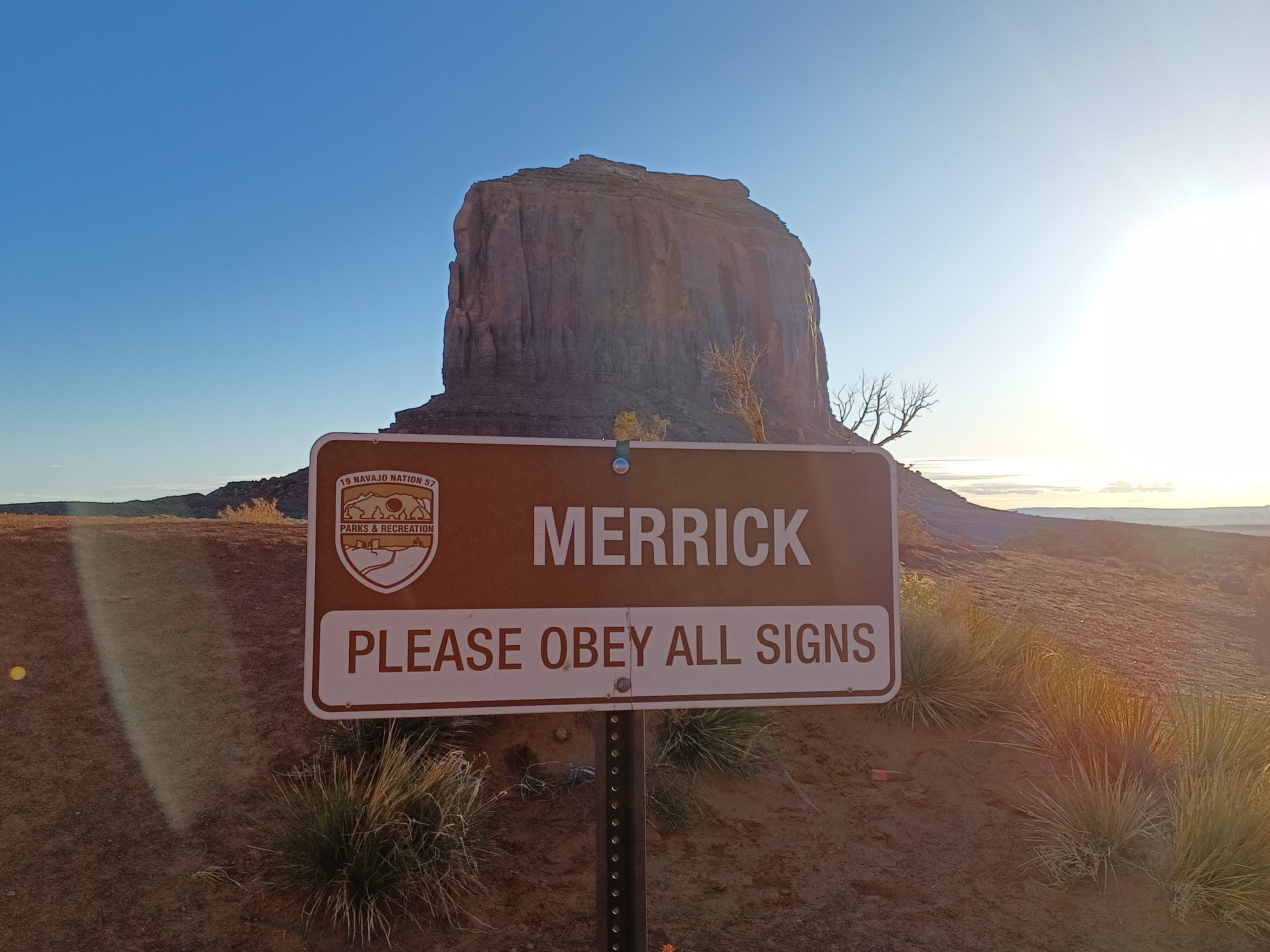
Monument Valley on the Navajo Nation, photographed March 2023
Merrick Garland gained national prominence when he was blocked from the Supreme Court by Republicans in 2016. The refusal of the GOP to hold hearings gave the Americans the false impression that Garland is a staunch Democrat and defender of liberty.
The week before my country stopped having a government and started having a king, I went searching for the Great Unconformity. I drove cliffside five thousand feet high, gazing down at crushed cars that didn’t make it.
The Great Unconformity is evident only in its absence. It does not tell the whole story but highlights missing chapters — if you already know enough to know that they are missing. It is lost time in its most literal sense, deleted history bracketed in rock.
I was looking for the Great Unconformity because I wanted assurance I could find it — that I was still sharp, still nobody’s fool. I’m going to need those skills, because our present is dying a little more every day.
We are heading into a future without a past. That is nothing new for autocracies. Pol Pot proclaimed history irrelevant and started his rule at Year Zero. Stalin pioneered the deletion of dissidents a half century before photoshop. The US, the British, and Israel peddled tales of “lands with no people” while murdering the indigenous people inhabiting them.
Every founding national myth contains a lie. The cruelest lies are those that succeed through erasure.
As the US lurches to autocracy, I turn to geology, because it is an honest broker. It retains every painstaking detail: rocks that grow an inch each millennium, fossils encased in stone. Every rock is a coffin, every coffin is a book.
Geology is an ally at the end of the world. It assures you there was a world, there is a world, and you are part of it.
Except, of course, for The Great Unconformity.
Sarah Kendzior
The Great Unconformity is a mystery: a gap of missing time in the geological record between 100 million and 1 billion years long. Traces of it are found in rock formations around the world. There are competing theories as to how The Great Unconformity happened — erosions, explosions. The evidence of absence looks different depending on where you go.
My husband and I began our search for The Great Unconformity by accidentally entering the Colorado National Monument. This would seem impossible, seeing as the Colorado National Monument is 20,000 acres of canyons with sheer cliff walls, but we managed to arrive with oblivious aplomb.
The culprit was a battered guidebook of “America’s Most Scenic Drives” that has sat in the backseat over our twenty years of marriage. I flipped through it on a whim while my husband drove, checking out the Colorado section.
“It says here,” I read, “that if we go to Grand Junction, drive six miles past a cattle guard onto a dirt path, turn onto something called Divide Road, and find the creek that flows two ways, that we’ll have a perfect view of The Great Unconformity!”
My husband agreed that this was a great idea. A mountaintop is a bad place for whims.
We made it to Grand Junction, failed to find a cattle guard, lost GPS, and wound up on the entry road to the Colorado National Monument. We paid the entrance fee, figuring our dirt path maybe got turned into a national monument sometime after the guidebook was published. We were Missourians in Colorado, high on altitude and delusion.
“Do you know where the Great Unconformity is?” we asked a cashier at the gift shop.
“The what?”
“The Great Unconformity!” we cried.
“What does it look like?”
“Nothing!” we said. The Seinfeld of geology.
“Then why are you looking for it?”
“Because we want to see things that aren’t there!”
To the relief of the clerk, a park ranger appeared, confirmed that there was indeed something called The Great Unconformity in the park, but that it was “like, everywhere — there, only not there. You’ll know it when you don’t see it. It’s hard to explain.”
At the Colorado National Monument, The Great Unconformity appears — or doesn’t — as a gap between the brick-red Chinle Formation of 210 million years ago, and the dark gray igneous rocks from the Precambrian era of 1.7 billion years ago.
What happened in between? Who knows. Two layers of time sit on top of each other, like everything’s cool, like there’s not an invisible billion-year mystery gap. All is red or brown or grey and laden in shadow. We were supposed to notice when something looked off and use our knowledge of what looks normal to render that judgment.
“I think I see it,” my husband said at every bend.
“Where?”
“It’s that thing.”
“What thing?”
“You know, the grey, the red — that thing!”
“Oh yeah, that’s it! Or under it. Or above?”
“Or that’s not it at all,” he said sadly.
“Why are you so obsessed with finding nothing when there’s so many things to look at?!” our son demanded from the backseat. He was alone; our daughter was at camp. He was stuck on a road trip with Vladimir and Estragon for parents.
“Finding nothing is important,” I said, “because it’s not there, and we don’t know why! So we need to see it, and then we’ll know.”
“Know what?”
“Why there’s nothing instead of something. Or how. How nothing replaced something.”
“Who cares?”
“I’ll care when our time is labeled nothing, too,” I said, but only in my mind.
Out loud, I told him to get good pictures of the cliffs to show his sister.
Maybe he’d find The Great Unconformity, and capture it, and I’d rest, knowing it could be done.