Silly Sisters, the duo of Maddy Prior and June Tabor, recorded “Doffin’ Mistress” for their 1976 self-titled album, Silly Sisters.
Month: August 2025
Servants of the Mafia State: Thank you, Merrick Garland
The Sarah Kendzior Newsletter
This article was originally published November 15, 2023
I do not want to talk about Merrick Garland again. It feels like doing homework for a class my country already failed.
But it is necessary to do so. There is a shroud over the USA. It is woven of decades of deceit and impunity, but it is not interminable. There are threads that, when pulled, cause the shroud to unravel and Americans to see the light.
One of those threads is Merrick Garland’s rise to power, and the role of his mentor and lifelong best friend, Jamie Gorelick, in that rise.
I have told this story in pieces over the years. I am now putting the information in one article to make it easier to find. The story touches on so many atrocities that it is impossible for me to cover them all, and I encourage folks to pick up where I left off. The point of describing a crisis is to give people tools to fix it. This shadow network affects everyone, regardless of where you live or for whom you voted.
It is common to hear Garland described as an institutionalist. This is true. He protects a broken and corrupt institution, the Department of Justice. He protects it instead of protecting the United States or its people. He protects it above democracy or freedom or a future. He protects it over justice itself.
The DOJ Industrial Propaganda Complex that emerges when any critique of Garland is made insists that justice is imminent. They bleat that Garland is merely “dotting the I’s and crossing the T’s”.
Which he is, in the word COMPLICIT.

Merrick Garland is a cog in the Biden Placeholder Presidency. He serves to streamline an aspiring autocracy into an entrenched one. You can read about that process here.
The Biden Placeholder Presidency was designed to exist between two terms of Trump, Mafia Grover Cleveland style. The threat of Trump returning to office to complete his autocratic agenda is severe. But that he is able to do it – that the US is the only country in history to allow a coup to go unpunished and a seditionist to run for president again – is due to Garland, the DOJ, and their accomplices in Congress.
Garland is not unique in his role as a mafia state enabler. He follows a long line of DOJ cover-up operatives marketed as saviors of American democracy: James Comey, Robert Mueller, Bill Barr, Cy Vance, and so on. Over and over, Americans are told that these prosecutors are going to “get Trump” and dismantle his criminal network. Over and over, they serve their real role, which is to run out the clock and allow criminal elites to escape accountability.
Theirs is a time-tested strategy. It is a necessary strategy, since members of the DOJ have worked, or continue to work, for the very transnational criminal networks they claim to fight. Among them are William Sessions and Louis Freeh, FBI heads who went on to serve Semyon Mogilevich and his transnational mafia operation. I explain this complex network in my books Hiding in Plain Sight and They Knew.
The FBI and DOJ need to protect Trump, because in doing so, they protect themselves.
Trump knows what crimes the US government carried out because he and officials in his orbit abetted them or witnessed them. These servants of the mafia state would not intervene even when public safety was at grave risk. The longer they waited, the more power Trump accumulated.
As a career criminal with deep ties in business, media, and organized crime as well as access to classified information, Trump now has more leverage over the American government than they do over him.
There are a lot of ways to blackmail a government. Not all of it has to do with individuals and their personal secrets. You could expose horrific prior actions a government did against its own people, for example.
Unspeakable things.
* * *
Trump is a career mafioso trained in the arts of blackmail and bribery by his mentor, Roy Cohn. He and his backers continually threaten physical violence against anyone in their way. But it is not necessary to deploy threats when the ostensible target – the DOJ — is their willing accomplice.
Many fail to understand Garland’s role due to an elaborate propaganda network (the mechanics of which I will break down) and a reluctance to recognize complicity among officials who are often portrayed as feuding. It is easier to attribute disaster to one political party instead of examining networks and recurring figures responsible for a multitude of tragedies over the past twenty-five years.
Jamie Gorelick is one of these figures, a Forrest Gump of 21st century corruption. Like Garland, she is a Democrat who serves GOP objectives, the most notable of which for Garland was working as Ivanka Trump and Jared Kushner’s lawyer and getting them the White House clearances that they should have been denied due to conflicts of interest.
As a result of Gorelick’s actions, Kushner gained classified intelligence that he likely shared with or sold to foreign states, including Saudi Arabia, from which he pocketed two billion dollars, and Israel, to which he has been tied since birth due to his family’s long friendship with the Netanyahu family, to the point that Benjamin Netanyahu slept in Jared’s bed when visiting the United States.
Garland has refused to investigate Kushner. A likely reason is that, were he to investigate Kushner – who remains a profound national security threat – he would also be investigating his best friend.
It is one big club, and it is destroying our country.
Crises of institutional integrity are beyond partisanship. They cannot be fixed by elections. They can only begin to be remedied when the rot is revealed. The road to accountability begins with evidence, context, and history.
Reckoning with this horror is difficult, but an informed public is a powerful public. Never forget that state officials are paid to serve you. You deserve more than a plate of platitudes meant to weaken your capacity for critical thought.
You deserve the truth, as unpleasant as it may be.
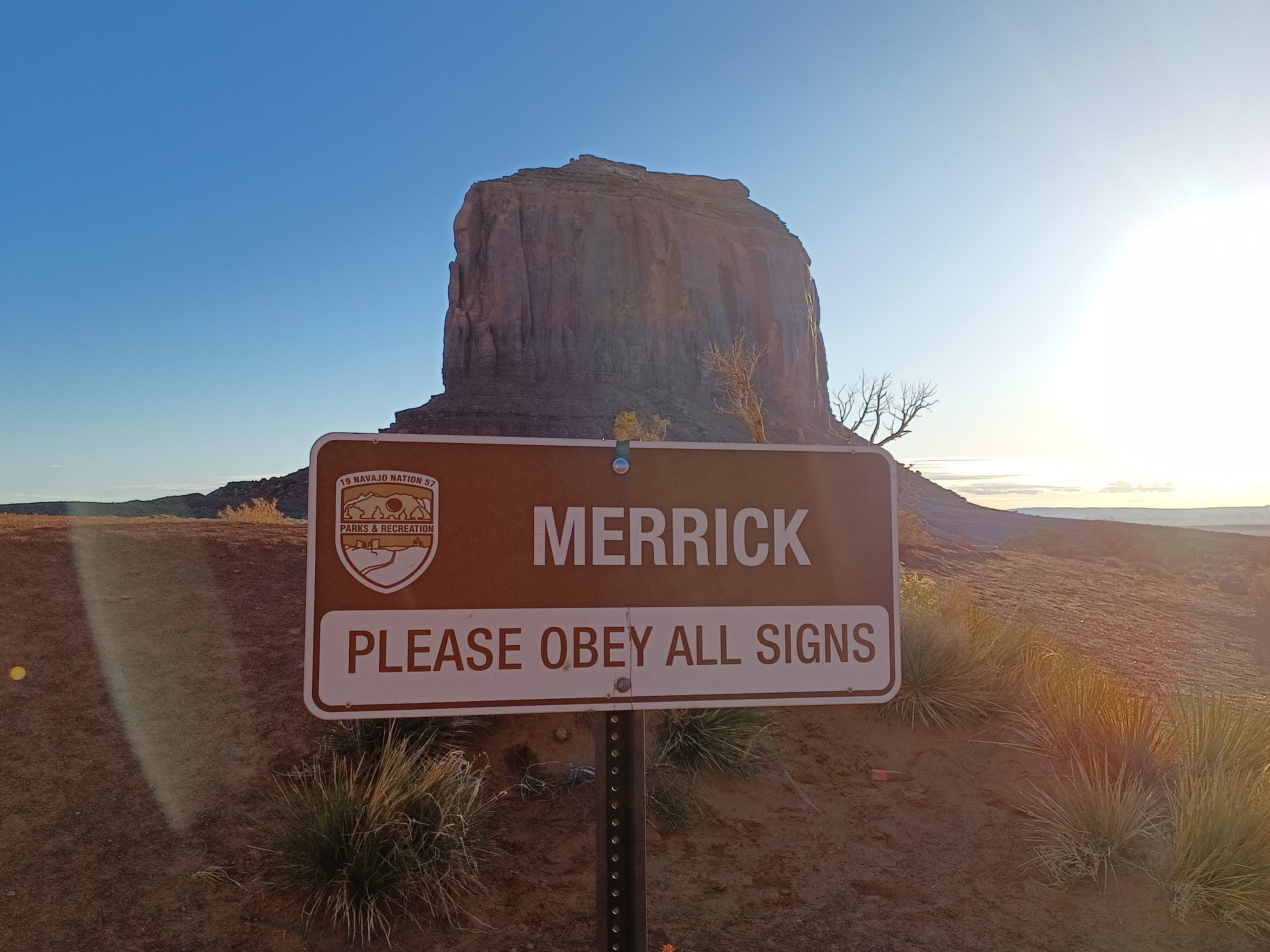
Monument Valley on the Navajo Nation, photographed March 2023
Merrick Garland gained national prominence when he was blocked from the Supreme Court by Republicans in 2016. The refusal of the GOP to hold hearings gave the Americans the false impression that Garland is a staunch Democrat and defender of liberty.
June Tabor & Oyster Band "Love Will Tear Us Apart"
The incomparable June Tabor the Oyster Band performing Joy Division’s “Love Will Tear Us Apart” from’ Later with Jools Holland 18th May 2012
My Friend Leatherface
Remembering a creative conservationist as plutocrats take a chainsaw to Texas.
By Sarah Kendzior | Aug 19, 2025
We pulled into Bastrop around noon. This is a bad move: everyone knows you don’t go to a rundown gas station in small-town Texas unless you’re looking for trouble. We were, so we walked right in.
The Gas Station is the only major surviving site from The Texas Chainsaw Massacre, the 1974 low-budget classic by Austin director Tobe Hooper, who cast local unknowns in leading roles and filmed in rural areas near the city. An exploration of human savagery more artistic than its title implies, the film tells the tale of road-trippers who stumble upon a family of sadistic cannibals. It is visceral, violent, and at times, beautiful.
The final shot — masked killer Leatherface twirling his chainsaw in the haze of the rising sun, unpunished and unexplained — is cinematic poetry. A light so lovely, it makes the darkness feel worse. It is a very American story.
I was in Austin on book tour and I wanted to see The Gas Station. Now I could, thanks to an unexpected break. An NPR host had blown me off for the second time after making me wait for his call like a 1950s schoolgirl. I was annoyed but had hours to kill and knew just the place for killing.
My husband and I set off for Bastrop, letting the capital fade from view. Austin was unrecognizable from my last visit in 2018. Tech oligarchs had built a skyline of skyscrapers that loomed like landing pads for bad ideas. Driverless cars zipped through bitcoin-bathed streets. The conspiracy theorists work for right-wing think tanks and nobody there is slacking. On the outskirts lurks Tesla, where a chainsaw-wielding Elon Musk rips through Austin’s famed weirdness and affordability.
I didn’t want to feel scared, so I headed to the site of The Texas Chainsaw Massacre.
* * *
Today The Gas Station is a barbecue joint that sells horror memorabilia. I had read it had items from the original Chainsaw, but that is no longer the case. They had them once, the owner said, but then the Californians ruined everything.
The Californians ruined everything is a phrase I was hearing a lot in Texas.
The owner explained that an entertainment corporation had forced them to transform their TCM pilgrimage site into a generic chop shop due to an alleged copyright infringement, despite the store’s connection to the original film. He spoke with the aloofness of someone used to greeting the disappointed.
“You can get barbecue,” he said with a shrug, gesturing at the cannibal-themed menu. “Or whatever.”
“I’m sorry this happened,” I said. “This is a national landmark. You should get to revive it. I’ve wanted to come here a long time. I used to write for Fangoria.”
He did a double take. We started talking. You hear about the coldness of Americans, but everyone warms up when you love what they seek to preserve.
I’d spent my book tour road trip getting pleasant surprises: swag from the Oklahoma Music Hall of Fame after I asked about neglected outlaw singer Sammi Smith; a print from the daughter of a Cherokee artist after I showed her a photo I’d taken of an obscure painting by her father in a museum years ago, and told her of my search for a copy, which she made for me in her studio. When your interests are strange, no one is a stranger.
The Gas Station owner regaled me and my husband with tales of the venue’s glory. He brought us out back to reveal a prop severed head in which he showed great pride. He mentioned Gunnar Hansen, the University of Texas graduate student who took what he thought would be a quick and amusing gig playing Leatherface, only to have it dominate his life. Hansen passed away at 68 in 2015.
“Leatherface was my phone friend!” I exclaimed.
“Who?”
“Leatherface! I mean, Gunnar,” I said. “When I was in college, I was supposed to interview him about Chainsaw. But we ended up talking about everything. Carl Jung and horror literature and the collective unconscious. Ocean life and ecology. He could recite Moby Dick. He made me want to go to Maine.”
“I proposed to you in Maine,” my husband interjected. “Maybe that should be your top memory of Maine.”
“It is,” I said. “But I was 20 and didn’t know anything. Leatherface gave me life advice.”
I had gotten Gunnar Hansen’s phone number through a friend of a friend from Lubbock. He agreed to speak to me, even though I had nowhere to publish my piece, and ended up using it for a college class in non-fiction writing. A former graduate student in English, Hansen didn’t mind. For one week in 1999, I called him multiple times for “follow-up questions”. That was a front: I wanted to keep talking. He understood things I was only beginning to grasp.
I wondered what I would be like in middle age, and I decided that if I was like Gunnar Hansen, I’d be doing just fine.
* * *
He could have cashed in early, but he didn’t care. When Chainsaw brought him fame, Hansen — the only Melville scholar to have his own action figure with a detachable severed head — quit acting. Inspired by the John McPhee essay “The Survival of the Bark Canoe,” he moved to the Maine woods to live in seclusion. He left university life behind as well. Hansen was wary of academia and Hollywood, describing them as industries where you’re expected to give pat answers to please bad people. He sought creative freedom above all.
“I wanted to write,” he told me. “That’s all I ever really wanted to do. If I was going to struggle and suffer and starve to try and develop my skill, I’d rather do it as a writer than as an actor.”
Over the next two decades, Hansen wrote five books, including poetry and travelogues about ecologically vulnerable regions of the United States. When I spoke to him in 1999, his most recent book, Islands at the Edge of Time, about East Coast barrier islands, had received a glowing review on a new book vendor called Amazon. The title of the review was “Leatherface Goes Island-Hopping.”
Hansen got used to being typecast. It never deterred him from his intellectual pursuits, and he did not view those pursuits as separate from his background in horror. When we spoke after the Columbine shootings, I asked him about media accusations that horror films fuel real-life murder. Hansen sighed. He said he’d been getting this question for decades from people who didn’t like the answer.
“People go after horror films not because they’re violent, but because a lot of times horror films have values that contradict normal values,” he said. “That’s why people are so outraged. When Raiders of the Lost Ark came out, it was much more explicit than Chainsaw Massacre. No one raised a complaint about the explicit violence in a film that, to some degree, was aimed at kids. But when Chainsaw came out, Johnny Carson gets on TV and says that he’s offended that it didn’t get an X rating for its violence.
“What’s happening is that we’re going after these films not because of their violence. We see the violence as something we can hang on to. We’re offended by horror movies because we’re middle Americans who don’t want to see things in which the values are not the same. The vision in horror films is often very dark. We want to have a movie that tells us that everything’s okay.
“A horror film does not pretend that death is not horrifying. It does not pretend that violence is not bloody, grotesque, and painful. What’s irresponsible are the films that show violence with no ramifications.”
Hansen saw Texas Chainsaw Massacre as a rule-breaker: a movie of “impolite horror” that refused to offer clarity or resolution. He saw a similar ambiguity in his favorite book, Moby Dick, which he encouraged me to read once a year.
“There’s the deep unconscious that the sea represents, if you want to be Freudian about it,” the Texas Chainsaw Massacre star explained. “Or, as Jung said, the lake in the valley of the unconscious. At the same time, it’s a tragedy about Ahab. There are so many different things going on but what worked particularly for me was that it was dipping into the idea that there was this mass of unknowability. It’s this huge book that has all these seams in it.
“Sometimes you read something and you feel that everything is polished as smooth as a stone. I never had that feeling with Moby Dick. The book was bigger than the author. It was like he had lost control over it, and that’s what I loved about it.”
When I used a quote from Moby Dick as an epigraph in my book They Knew — a book I structured as a non-fiction horror story to convey the pain of the political moment in a palatable way — I thought of Gunnar Hansen.
* * *
He told me to see the wilderness before it was too late. In 1999, I had barely traveled, and he encouraged me to explore the country, to visit his beloved Maine, to cherish fragile lands. He worried about the future my generation would inherit. When I look back on our chats, we were two people obsessed with death because we loved life.
Gunnar Hansen made me feel normal. It was normal to love Moby Dick and The Texas Chainsaw Massacre. It was normal to abhor violence and watch horror for entertainment, in the hope that somehow the entertainment would convey the grief in the American air, even in that glorious illusion of 1999, the sole year I could be called an optimist.
I never spoke to him after that week. Sometimes you have a brief encounter and it shapes your life without you realizing it. A gentle man famed for playing a serial killer taught me I never had to choose one way to live or to be. I could be of the world, and that was enough.
You’re not a contradiction in terms when you’re the one writing the terms. It’s a lesson I wish younger people — sorted into boxes not only by social pressure, but by panopticon data miners — understood through experiences beyond life as prey.
If the seas shall rise, let the mass of unknowability rise too.
* * *
In 2013, Hansen, who started making horror cameos in the late 1980s but kept his movie persona separate from his writing, published an amusing tell-all called Chain Saw Confidential. Chapter One begins: “Call me Leatherface.”
But his description of Texas Chainsaw Massacre’s ending sounds like a 2025 news report, if 2025 still had news:
“The monster goes unpunished. He is still there, still capable of returning. The normality, the predictability of the world is gone. There is no punishment. There is no relief of suffering. There is no justice. There is no order. Without justice and order, how can we have meaning? It is all nothing. This is the real horror.”
Hansen died of pancreatic cancer before Trump took office, autocracy spread worldwide, and climate catastrophes devastated the lands he loved. He died before a technofascist belief in human disposability became mainstreamed into global politics: an extinction racket that shuns even the pretense of valuing life.
He died before Trump started talking up Hannibal Lecter. Trump ignored fellow cannibal Leatherface: Leatherface is too impolite, too raw in his menace. Gunnar Hansen feared the polished villains. I don’t need to wonder what he would think of the plutocrats who destroy the natural world to build an AI facsimile.
On our last night in Texas, my husband and I drove the same Austin streets that Hansen did a half century ago in an America that had hit its peak without knowing it. Texas Chainsaw Massacre mocked the idea that Americans were free, but the film felt free — ruthlessly, frantically free, like it was gathering a dark truth before the means to share it were foreclosed.
The sequels and remakes that followed heralded the narrowing of vision that led to our current dystopia: movies made by robots to pander to the unimaginative.
Near the Congress Avenue Bridge, a crowd was growing. We joined them as dusk fell. I liked the night because I couldn’t read the QR codes. I liked the night because I could pretend Austin was old Austin, and it was 1999, and the future lay before me instead of behind me.
Then it happened: hundreds of thousands of bats emerged from under the bridge. The bats were resolute in flight, impervious to tech lord transformations. The crowd cheered. Here was nature, unrepentant. Here was a timeless symbol of horror stories engendering our shared humanity. Austin felt good again, alive again.
There’s a crack in the dystopia. That’s how the night gets in.
* * *
Thank you for reading! I would never paywall in times of peril. But if you’d like to keep this newsletter going, please consider becoming a paid subscriber. That ensures every article in the archives remains open to everyone. This newsletter is the main source of income for my family of four, so I appreciate your support!
Thank you for reading! I would never paywall in times of peril. But if you’d like to keep this newsletter going, please consider becoming a paid subscriber. That ensures every article remains open to everyone. This newsletter is the main source of income for my family of four, so I appreciate your support!
Sarah Kendzior’s Newsletter is a reader-supported publication. To receive new posts and support my work, consider becoming a free or paid subscriber.